In 2018, I visited Berlin’s East Side Gallery to see one of its most iconic and thought-provoking artworks, The Kiss, painted on a surviving section of the Berlin Wall.
Officially titled My God, Help Me to Survive This Deadly Love, the mural by Russian artist Dmitri Vrubel captures the famous embrace between Soviet leader Leonid Brezhnev and East German leader Erich Honecker.
The painting, based on a real photograph taken in 1979 during the 30th anniversary of the German Democratic Republic, depicts the socialist fraternal kiss in vivid, almost shocking detail. Vrubel’s bold brushstrokes and the mural’s sheer size make it hard to ignore, and over the years it has become one of Berlin’s most photographed landmarks.
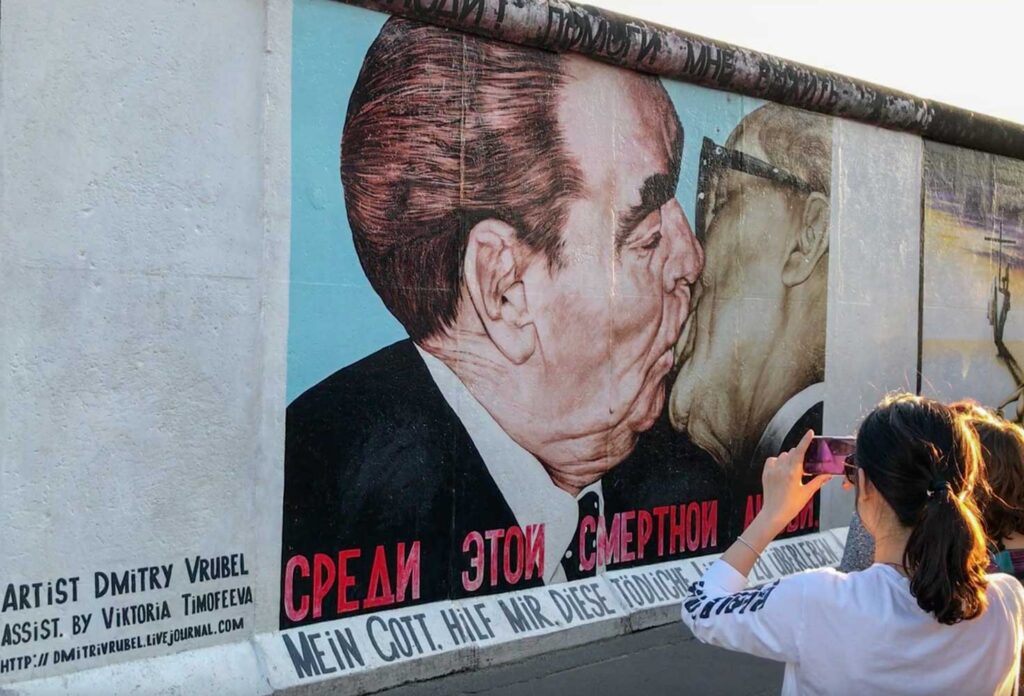
Located along the East Side Gallery, a 1.3-kilometre stretch of the former Berlin Wall transformed into an open-air art gallery, The Kiss stands among more than a hundred murals created by international artists after the Wall fell in 1989. Each piece carries its own message, but Vrubel’s work has endured as a particularly striking symbol of political irony and human emotion.
By 2018, the mural had already undergone restoration to preserve its appearance, and it continued to attract thousands of visitors daily. Standing before it, you can still feel the tension between history and art, the contrast between oppression and expression that defines so much of Berlin’s modern identity.
It remains one of those rare works that manages to be both visually arresting and deeply symbolic, a reminder of how far Europe has come, and how powerfully art can reflect the spirit of change.
If you’re heading to Berlin, this is one attraction you truly shouldn’t miss.